By Mac Walters
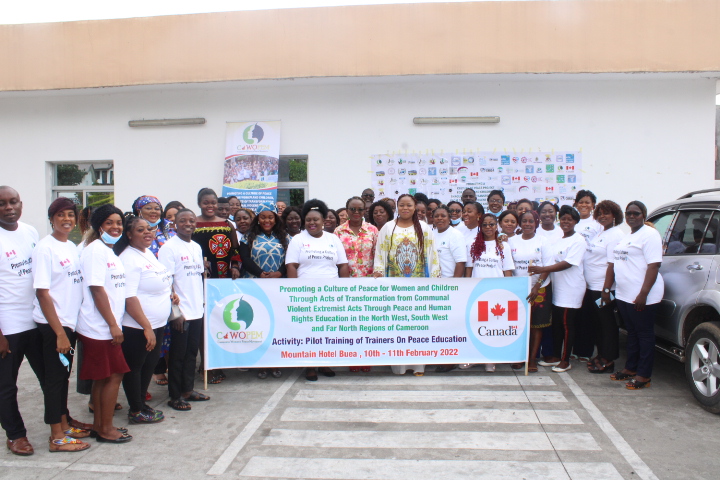
Stakeholders across various sectors recently gathered to refine strategies for promoting a culture of peace in conflict-affected areas of Cameroon. The two-day Training of Trainers Workshop on Peace Education, held in Buea from February 11–12, 2022, was organized by the Cameroon Women’s Peace Movement (CAWOPEM) under a project funded by the Canadian High Commission in Cameroon.
According to Dr. Dorothy Fosack, a founding member of CAWOPEM, the seminar aimed to instill peace as a core value in individuals who can, in turn, spread it to others.
“Peace culture is not well understood by many,” she noted. “You need to be peaceful as a person for peace culture to grow. We are training individuals who will teach others what it means to be peaceful so that the culture of peace can spread.”
The workshop brought together over 100 participants, including teachers, community leaders, women leaders, and religious figures, with women making up the majority. Dr. Fosack emphasized the critical role of women, stating,
“Women, as childbearers and caregivers, are the foundation of every society and play a key role in promoting peace culture. However, we’ve also included men in this seminar because building a peace culture requires interpersonal collaboration.”
Target Regions and Project Goals
CAWOPEM’s General Coordinator, Caryn Dasah, explained that the initiative, titled Building a Culture of Peace, focuses on three conflict-impacted regions: the North West, South West, and Far North.
“This project didn’t start here. We’ve organized similar activities in Mora in the Far North, as well as in Bamenda and Buea. The goal is to integrate peace into daily interactions and inculcate these values into the lives of all Cameroonians,” Dasah said.
The project is being implemented in phases:
- School Peace Education: Initiated in December, this phase introduced peace and non-violent communication programs in schools.
- Intergenerational Dialogue: Engaged traditional leaders, women leaders, and men to redefine community dialogue structures for fostering peace.
- Training of Trainers Workshop: Focused on equipping teachers, community leaders, and religious figures with the tools to promote peace education and conflict resolution.
Key Outcomes and Resources
At the end of the seminar, CAWOPEM produced a manual on peace education to serve as a guideline for participants as they return to their classrooms, communities, and other settings to promote peace.
One participant, Atefor Yvodia, a primary school teacher, described the training as timely and essential.
“As a teacher, I’ve learned strategies to teach peace education to my learners as part of their curriculum. Additionally, as a woman and wife, I’ve gained skills to manage conflict situations at home and in society,” she shared.
Seminar Highlights
The workshop featured presentations and discussions on:
- The CAWOPEM Peace Education Manual
- The role of women in peacebuilding
- The impacts of armed conflict on women and girls
- Non-violent and effective communication
- Action planning for peace promotion in schools and communities
Participants left the workshop equipped with tools and actionable strategies to foster peace and address conflicts within their communities.
Conclusion
Through initiatives like this, CAWOPEM continues to empower individuals and communities to embrace peace as a way of life. With the support of partners like the Canadian High Commission, this project is making meaningful strides toward transforming conflict-affected regions into hubs of peace and coexistence.